

Shipping Containers Market - Demand, Competitive Insights, Market Size
The global container system was built for predictable trade. Trade is no longer predictable and that mismatch could create the industry’s next major opportunity.
Wilmington, DE, United States, Sept. 08, 2026 (GLOBE NEWSWIRE) -- Shipping Containers are Emerging as one of the Most Strategically Controlled Assets in Global Trade
The conversation around global trade has shifted faster than most procurement strategies have. What was once a commoditized box business is now a structurally important asset class, with leasing economics, manufacturing concentration, and specification requirements that look almost nothing like the pre-2020 baseline. Strategy teams continuing to treat box procurement as a transactional line item are quietly losing optionality to those who started treating it as infrastructure.
The Shipping Containers Market is being reshaped by a combination of trade route reconfiguration, cold chain expansion, and the unbundling of fleet ownership from vessel operation. Demand is no longer linear with global GDP, and the supply side has consolidated around a smaller set of manufacturers with real pricing power. The window in which buyers could rely on abundant, cheap, generic capacity is closing without much public discussion.
Request a Free Sample Report: https://marketmindsadvisory.com/request-sample/?report_id=12
Key Takeaways from Shipping Containers Market
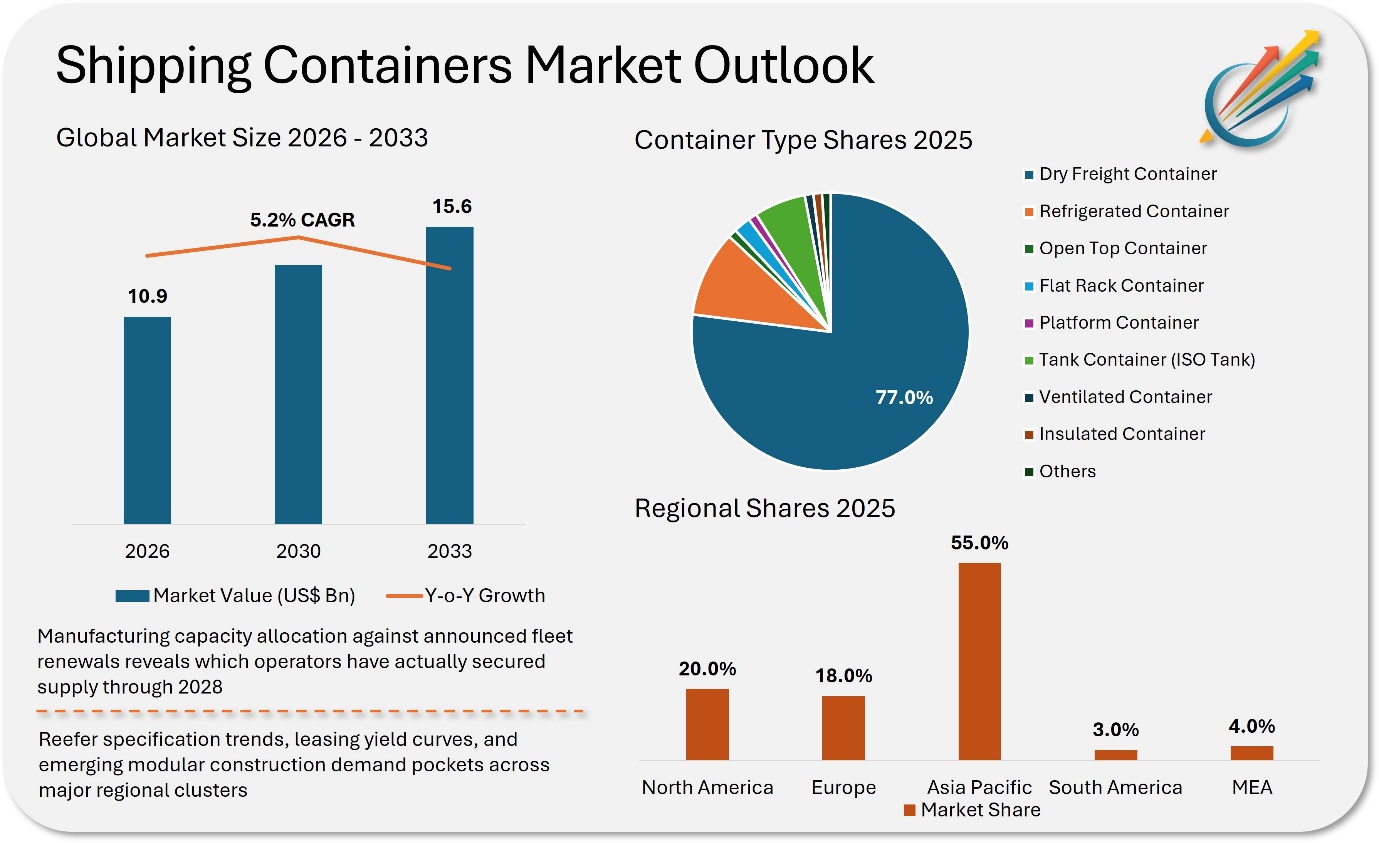
- The global shipping containers market is projected to reach US$ 15.6 Billion by 2033, up from US$ 10.9 Billion in 2026
- The shipping containers market is expanding at a CAGR of 5.2% between 2026 and 2033
- Refrigerated container demand is outpacing dry freight growth as perishables trade expands across emerging corridors
- Chinese manufacturing accounts for the dominant share of global new-build supply, concentrating pricing leverage
- Leasing companies are absorbing a growing share of fleet ownership, decoupling boxes from shipping line balance sheets
- Modular housing and offsite construction are emerging as a meaningful non-trade demand category
- Specification fragmentation is rising as cold chain, hazardous goods, and project cargo create premium sub-segments.
As per Lead Analyst from Market Minds Advisory, "The directional conclusion is straightforward. Buyers who lock in manufacturing relationships and leasing terms in the next four to six quarters will operate on a measurably different cost base than those who continue treating containers as a spot-market purchase."
Current Procurement Cycle Could Redefine Long-Term Fleet Economics Across Global Trade
The next 18 months will determine which operators emerge with structurally advantaged cost positions and which absorb permanent disadvantages in their unit economics. The shipping containers market is moving from a buyer's market to a more selective one, and the players who recognize this early are already adjusting procurement behavior.
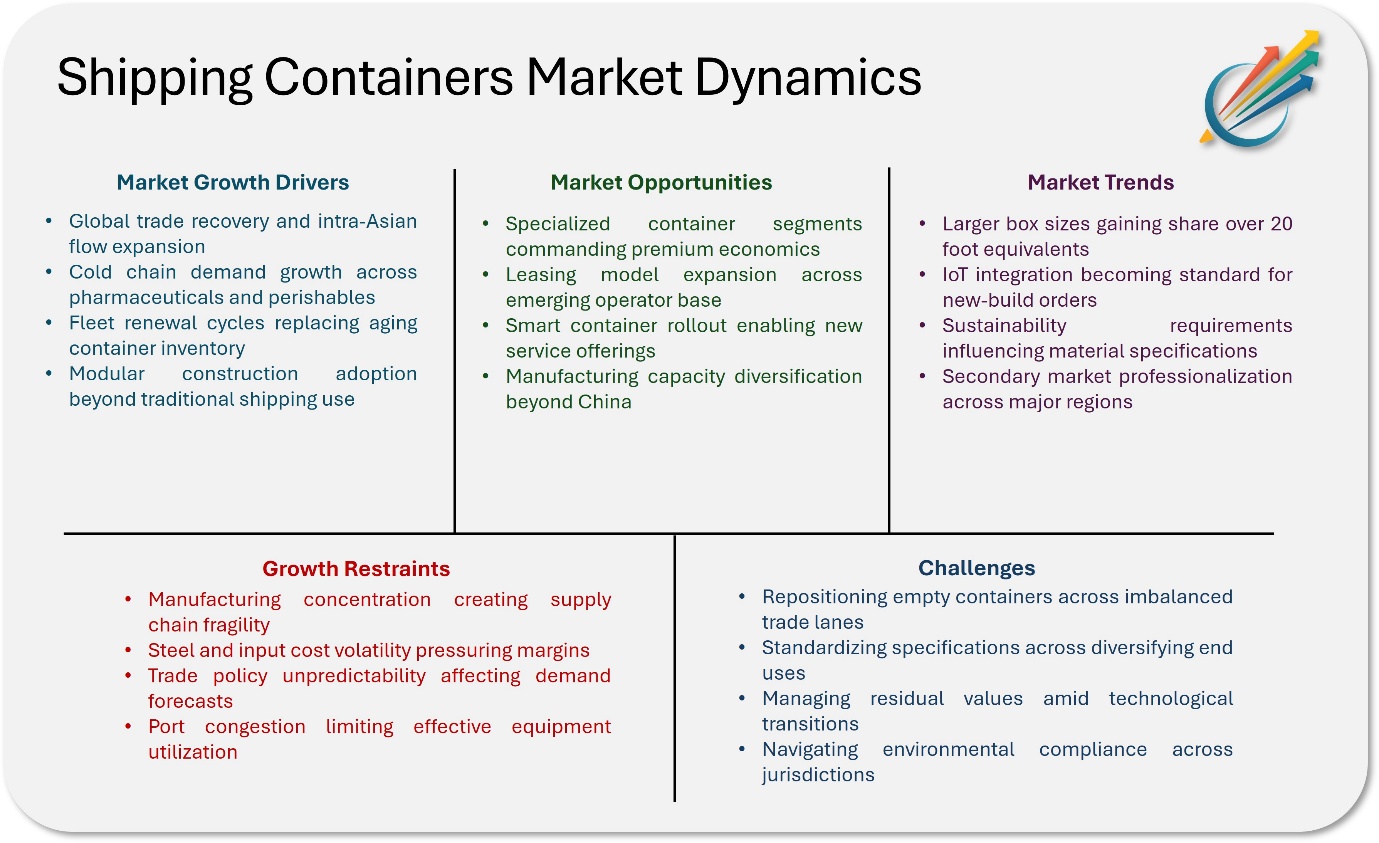
- Manufacturing concentration is tightening pricing leverage: A small number of Chinese manufacturers now control the majority of new-build output, which means cyclical price softness will be shorter and shallower than historical patterns suggest.
- Fleet renewal cycles are colliding with specification upgrades: Operators replacing aging boxes are simultaneously needing to upgrade for cold chain, IoT tracking, and emissions-linked specification requirements, compressing decision timelines.
-
Leasing terms are being rewritten: Per-diem rates, residual value assumptions, and contract durations are shifting in favor of lessors, and the gap between sophisticated and unsophisticated lessees is widening.
Container Ownership Economics are Rapidly Separating from Traditional Shipping Operations
The structural shift most operators have not fully internalized is that container ownership is becoming a distinct business from container operation. This separation is reshaping who captures value in the shipping containers market across regions and segments.
- Leasing companies are becoming the de facto infrastructure layer: Operators are outsourcing balance sheet exposure to specialized lessors who can hold equipment across cycles, which is changing how fleet capital is allocated globally.
- Specification premiums are widening: Reefer, tank, and specialized boxes now command pricing power that generic dry freight never will, and the share of value sitting in specialized segments is growing each year.
-
Secondary markets are professionalizing: Used container trading, modular conversion, and end-of-life remarketing are no longer afterthoughts. They are becoming integrated profit centers for operators who treat them as such.
Shipping Containers Market is Moving in Directions Many Fleet Planning Models Still Underestimate
A meaningful portion of announced fleet expansion plans will be quietly downsized as financing conditions tighten and lessors absorb more of the marginal box demand. The headline orderbook overstates real net additions, and operators who model from announcement-level data will misjudge available capacity by a notable margin.
Refrigerated containers will become the defining battleground of the next cycle, not dry freight. Cold chain demand from pharmaceuticals, premium perishables, and intra-Asian food trade is growing faster than consensus projections assume, and reefer-capable supply is structurally tighter than the dry freight book suggests.
Modular construction will absorb a larger share of container output than current forecasts indicate. The conversion of new and used boxes into housing, site offices, data center shells, and disaster relief structures is moving from niche to material, and this demand is largely uncorrelated with trade volumes.
New Competitive Structure Emerging across the Global Container Ecosystem
Trade Route Reconfiguration
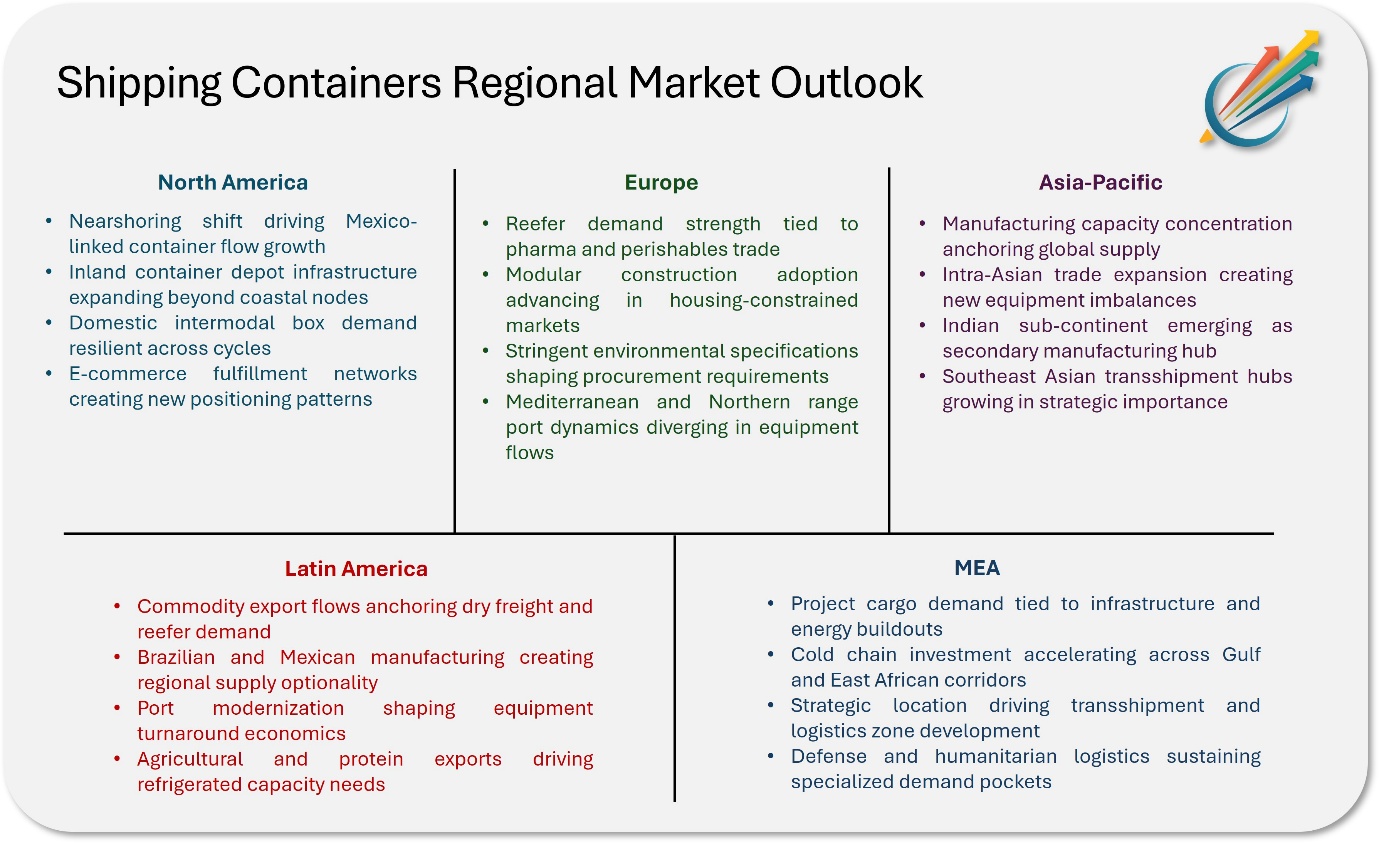
Trade flows are diversifying away from the historical China-to-West pattern toward intra-Asian, Africa-linked, and nearshoring corridors. This is changing where containers need to be positioned, how repositioning costs accumulate, and which ports become structural winners. Operators with rigid network designs are absorbing growing imbalance penalties, while those rebuilding around the new map are capturing margin that did not exist five years ago.
Cold Chain as a Growth Vector
The shipping containers market is being reshaped by the pharmaceutical, premium food, and floriculture trades that depend on reliable refrigerated capacity. Reefer fleet growth is structurally outpacing dry freight, and the specification bar is rising with each cycle. Companies positioned in genset-equipped, controlled atmosphere, and temperature-validated equipment are capturing pricing power that the broader market does not see.
Digital and IoT Integration
Smart containers with embedded tracking, condition monitoring, and digital twins are no longer pilot programs. Major shipping lines and lessors are rolling out connected fleets at scale, and the operational data being generated is becoming a competitive moat. The companies treating containers as data-generating assets rather than passive equipment are pulling ahead in route optimization and customer offering.
Manufacturing Geographic Diversification
The concentration of global container manufacturing in China is being slowly addressed through capacity additions in Vietnam, India, and select Eastern European locations. This diversification is partial and uneven, but it is meaningful enough to change procurement playbooks. Buyers cultivating relationships with non-Chinese manufacturers are building optionality that will matter in the next supply disruption.
Execution, Supply Concentration, and Regulation Could Reshape the Industry Faster than Expected
- Trade volume volatility: Global trade growth remains sensitive to macroeconomic shocks, tariff escalations, and geopolitical disruptions, any of which can compress demand sharply in short windows.
- Steel price exposure: Container manufacturing economics are tied to steel and corten input costs, and sustained input inflation can compress margins or push new-build prices beyond replacement-driven demand.
- Overcapacity cycles: The industry has historically oscillated between shortage and oversupply, and a coordinated manufacturing ramp could create temporary box surpluses that pressure leasing yields.
- Environmental regulation: Emerging emissions standards for refrigerant gases, manufacturing emissions, and end-of-life disposal could raise compliance costs across the supply chain.
- Geopolitical concentration risk: Heavy dependence on Chinese manufacturing creates exposure to trade policy actions, export controls, or bilateral tensions that could disrupt supply at short notice.
- Currency and financing volatility: A meaningful share of box transactions and leasing contracts are dollar-denominated, and FX or rate volatility can reshape regional procurement economics quickly.
These risks are real, but they moderate the pace rather than reverse the direction. The structural drivers reshaping the shipping containers market remain intact, and the binding constraint continues to be access to the right specification at the right time.
Market Dynamics Shaping the Shipping Containers Market
Shipping Containers Market Segmentation
By Container Type
- Dry Freight Container
- Refrigerated Container
- Open Top Container
- Flat Rack Container
- Platform Container
- Tank Container (ISO Tank)
- Ventilated Container
- Insulated Container
- Others
Dry freight remains the volume backbone of the shipping containers market, but the margin story is being written in specialized segments. Refrigerated containers are growing structurally faster as cold chain trade expands, while tank containers are capturing chemical and food-grade liquid bulk that previously moved in less efficient formats. Flat racks and open tops are seeing renewed demand from project cargo and renewables logistics, particularly wind component movement.
By Container Size
- 10 Foot Container
- 20 Foot Container
- 40 Foot Container
- Above 40 Foot Container
The 40 foot and high-cube formats continue to gain share at the expense of 20 foot equivalents, driven by cargo density economics and shipper preference for fewer, larger units. Above 40 foot configurations are finding niche traction in modular construction and specialized industrial applications. The 10 foot segment retains relevance for last-mile, military, and modular use cases where smaller footprints are operationally necessary.
By Project Scale
- Single Unit Purchases
- Fleet Scale Purchases
- Large Contract Procurement
Procurement behavior is bifurcating in the shipping containers market. Large contract procurement by shipping lines and major lessors anchors the manufacturing orderbook, while single unit and fleet scale purchases by modular construction firms, logistics SMEs, and storage operators are growing as a share of overall demand. The pricing power dynamics differ sharply across these buyer types.
By Application
- Dry Cargo Transport
- Refrigerated Cargo Transport
- Liquid Bulk Transport
- Break Bulk and Project Cargo
- Vehicle Transport and RoRo
- Hazardous Materials
- Modular Construction and Housing
- Cold Chain Logistics
- Military and Defense Logistics
Dry cargo transport remains the dominant application by volume, but the fastest-growing pockets are in cold chain logistics, modular construction, and hazardous materials handling. Each of these requires specification premiums and creates more durable customer relationships than commodity dry freight. Defense logistics and project cargo are smaller but offer attractive margins for operators with the right equipment mix.
By End User
- Shipping Lines and Container Operators
- Freight Forwarders and Logistics Providers
- Ports and Terminal Operators
- Retail and E-Commerce Companies
- Food and Beverage Companies
- Chemical and Petrochemical Companies
- Energy and Offshore Companies
- Defense and Government Agencies
- Leasing Companies
Leasing companies have emerged as the structural counterweight to shipping line procurement, and their share of global fleet ownership continues to expand. Retail and e-commerce buyers are increasingly procuring directly to control specifications and turnaround. Chemical and food companies are investing in dedicated tank and reefer fleets where third-party availability cannot guarantee reliability, reshaping the buyer landscape.
Shape this report around your priorities: https://marketmindsadvisory.com/request-customization/?report_id=12
Regional Market Outlook
Investment Focus where the Significant Opportunity is Anticipated
Refrigerated and Cold Chain Equipment
Refrigerated containers represent the most attractive risk-adjusted growth pocket in the shipping containers market. Pharma cold chain, premium protein trade, and floriculture are driving structural demand that is less cyclical than dry freight. Operators and lessors with scaled reefer fleets are commanding pricing power that the dry freight market cannot replicate, and this gap is widening each cycle.
Container Leasing Platforms
Leasing companies are absorbing balance sheet risk that shipping lines no longer want, creating a structurally advantaged position. The economics favor lessors who can underwrite across cycles, manage residual values intelligently, and offer flexible contract structures. Scale, capital cost, and customer relationship depth determine winners, and the top platforms are pulling away from sub-scale competitors.
Specialized and Project Cargo Equipment
Tank containers, flat racks, and open tops serve markets where specification matters more than price. Chemical logistics, wind energy components, and oversized project cargo all require equipment that commodity manufacturers do not optimize for. The companies investing in this specialized capacity are capturing margins that the broader shipping containers market simply does not offer.
Modular Construction Conversion
Container-based modular construction is moving from cottage industry to scaled offering. Housing shortages, rapid-deployment infrastructure needs, and data center edge build-outs are creating demand uncorrelated with trade volumes. Companies bridging container manufacturing capability with construction expertise are building defensible positions in a market that traditional shipping players largely ignore.
What This Means for Decision-Makers
Shipping Lines & Container Operators - Treating box procurement as a strategic asset rather than a transactional line item is now the differentiator in the shipping containers market. Securing manufacturing slots and leasing relationships through 2028 will define unit economics for the next decade.
Leasing Companies - The structural shift toward separated ownership is the most important tailwind in this sector. Scale, balance sheet capacity, and residual value expertise determine winners, and consolidation pressure on sub-scale lessors will continue.
Investors - The shipping containers market offers exposure to global trade with more attractive risk-return profiles than pure shipping equity. Leasing platforms and specialized equipment manufacturers represent the most defensible positions across cycles.
End-Use Industries - Retail, food, chemical, and pharma buyers should consider direct procurement or dedicated leasing relationships for mission-critical flows. The cost of equipment unavailability now exceeds the savings from spot-market sourcing for any specification that matters operationally.
Competitive Landscape: Shipping Containers Market
Recent Market Developments
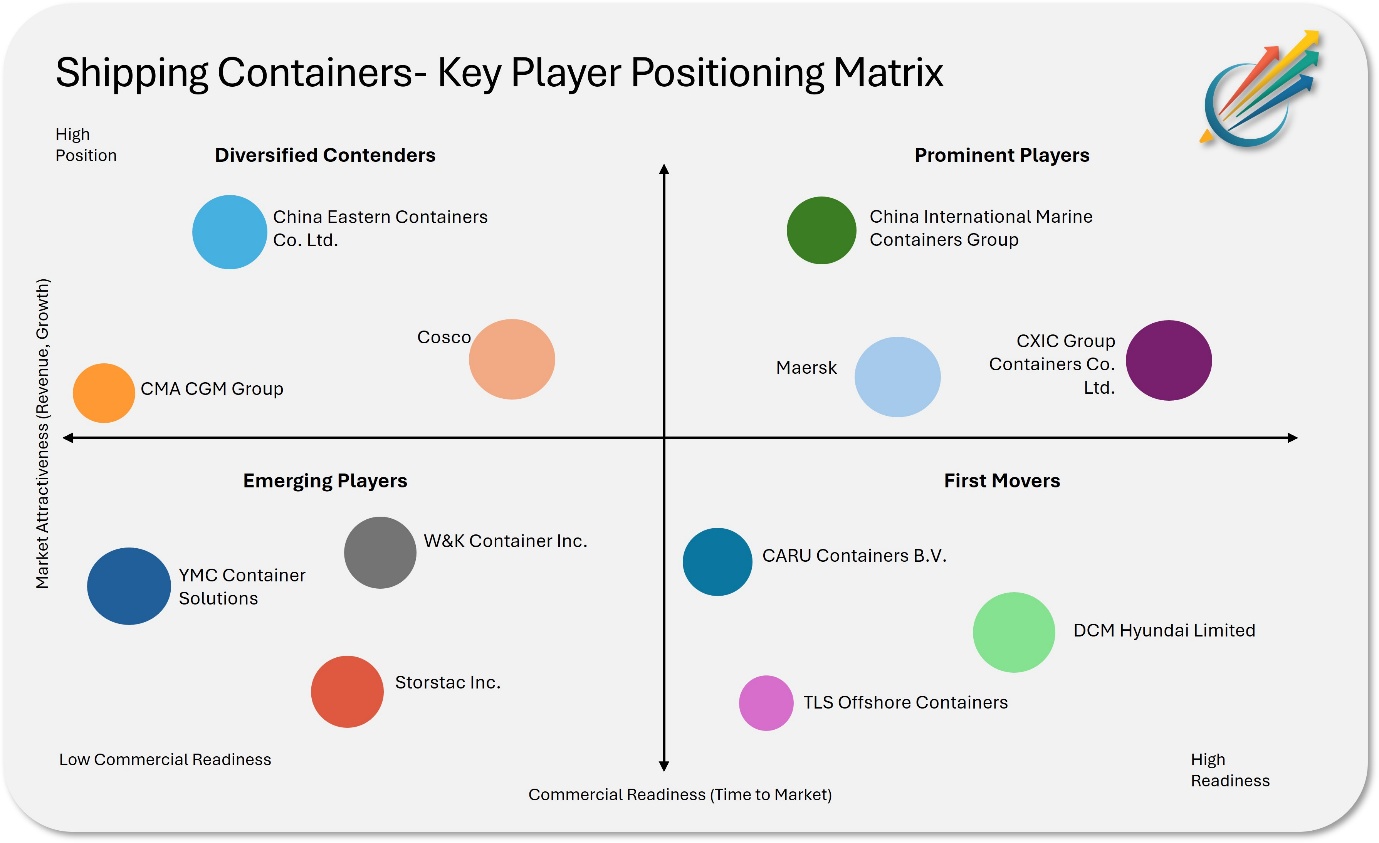
- In April 2026, China International Marine Containers Group announced expanded production capacity allocations to address rising reefer demand across global shipping operators.
- In February 2026, CMA CGM Group communicated continued investment in its container fleet renewal program, emphasizing specification upgrades for cold chain operations.
- In March 2026, Maersk Container Industry signaled strategic priorities centered on refrigerated container technology and integrated tracking capabilities.
- In January 2026, Sea Box Inc. highlighted expansion of its specialized container offerings for defense logistics and modular infrastructure applications.
Market is segmented by Container Type (Dry Freight, Refrigerated, Open Top, Flat Rack, Tank ISO), Container Size (10, 20, 40, Above 40 Foot), Application (Dry Cargo, Refrigerated Cargo, Liquid Bulk, Cold Chain), and End User (Shipping Lines, Chemical Companies, Leasing Companies)
Get Access to complete Analysis, Buy Now: https://marketmindsadvisory.com/buy-now/?report_id=12
Trending Reports
- Nestable Drums Market
- Intermediate Bulk Container Market
- 4-Wheeled Containers Market
- Foldable Container Market
- EPS Container Market
- PET Dome Lids Market
- PET Containers Market
- Grab and Go Containers Market
- Packaging Bins Market
- Locomotive Drive Shaft Market
Why choose Market Minds Advisory
Market Minds Advisory delivers decision-grade intelligence to executives across machinery, packaging, chemicals, automotive, ICT, food and beverage, consumer goods, and healthcare. We help organizations sharpen market expansion strategies, accelerate share gains, refine brand positioning, and enable account-level growth. Our forecasting integrates primary interviews, proprietary demand models, and continuous market validation, producing the kind of clarity volatile and emerging industries require. Backed by over a decade of sector expertise, our research surfaces white space, opportunity gaps, and competitive blind spots, accounting for recent developments and geopolitical risk. We help businesses see the future of their markets.
Contact Us
Market Minds Advisory
1521 Concord Pike, Suite 301
Wilmington, DE 19803
United States
Email: sales@marketmindsadvisory.com
Website: https://marketmindsadvisory.com/


Legal Disclaimer:
EIN Presswire provides this news content "as is" without warranty of any kind. We do not accept any responsibility or liability for the accuracy, content, images, videos, licenses, completeness, legality, or reliability of the information contained in this article. If you have any complaints or copyright issues related to this article, kindly contact the author above.
