

Digital Twin Market - Demand Innovation Market Size
The digital twin is evolving from a virtual replica into a decision engine connecting design, operations and AI to change where competitive advantage is created.
Wilmington, DE, United States, Sept. 08, 2026 (GLOBE NEWSWIRE) -- Digital Twin Adoption is Becoming a Strategic Requirement across Asset-Heavy Industries
The digital twin market has crossed the threshold from experimental capability to operational backbone for asset-heavy industries. What started as visualization software bolted onto existing operations is now being treated as a core layer of enterprise architecture, and the strategic consequences of that shift are still underappreciated by most boards reviewing technology budgets this cycle.
Beneath the surface of vendor announcements, a quieter realignment is underway. Industrial operators that built digital twin capability between 2022 and 2024 are now generating measurable returns through downtime avoidance and design acceleration, while late movers face the harder problem of catching up to competitors whose data assets compound monthly. The digital twin market is no longer about adoption willingness, it is about timing.
Request a Free Sample Report: https://marketmindsadvisory.com/request-sample/?report_id=34
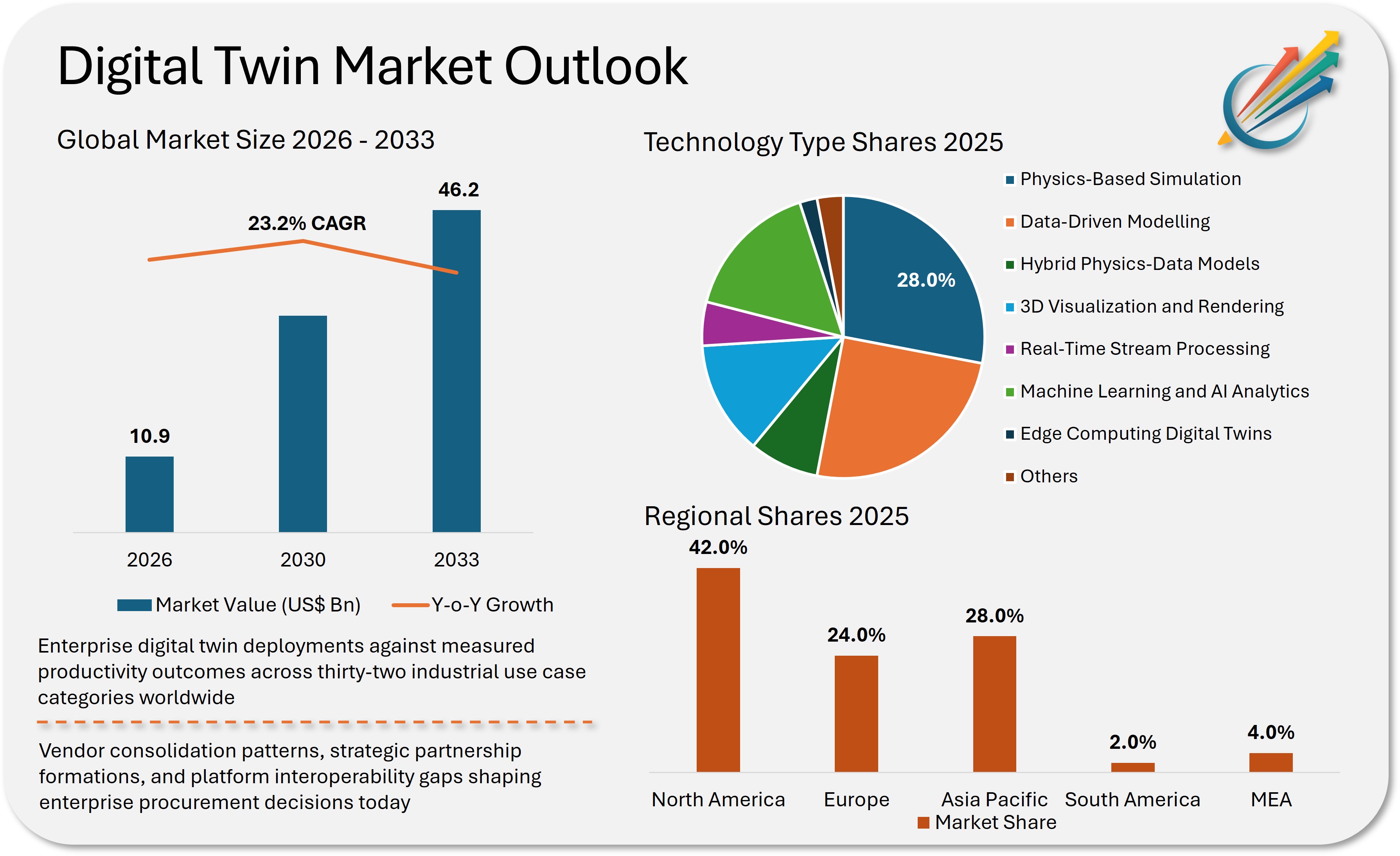
Key Takeaways from Digital Twin Market
- The global digital twin market reached US$ 10.9 Billion in 2026 and is projected to expand at a 23.2% CAGR through 2033.
- Total market value is forecast to reach US$ 42.6 Billion by 2033, more than tripling within a single capital cycle.
- Predictive maintenance applications now generate measurable ROI within 14 to 18 months for capital-intensive operators.
- Hybrid physics-data models are displacing pure simulation as the dominant architecture for industrial use cases.
- Edge-enabled deployments are emerging as the critical enabler for real-time applications in manufacturing and energy.
- The digital twin market is bifurcating between platform vendors and vertically specialized solution providers.
- Cloud-based deployment accounts for most new contracts, though hybrid architectures dominate in regulated sectors in digital twin market.
As per Research Manager from Market Minds Advisory, " The digital twin conversation has moved from whether to deploy to how fast organizations can operationalize at scale. The next 18 to 24 months will determine which enterprises build durable data advantages and which spend the rest of the decade reconciling fragmented pilot projects into something coherent."
Narrow Strategic Window is Emerging for Enterprises still Delaying Architectural Decisions
The digital twin market is entering a phase where early architectural decisions create lock-in effects that compound over multiple budget cycles.
- Data architecture is becoming the binding constraint: Enterprises that have not yet standardized their operational data layer will find that twin deployment costs scale non-linearly. The hidden expense lives in integration, not licensing.
- Vendor selection windows are narrowing: Major platform players are signing multi-year enterprise commitments that effectively close off certain procurement options for competitors. Buyers waiting for clearer pricing benchmarks may find fewer credible alternatives.
-
Workforce capability gaps are now material: Engineering teams capable of operating production-grade twins remain scarce, and compensation premiums have begun reshaping vendor staffing models across the digital twin market.
Value Shift in Digital Twins Market is Happening Beyond Visualization Software
The most consequential change in the digital twin market is not adoption rate. It is the repositioning of twins from isolated departmental software into a foundational layer that connects engineering, operations, and commercial functions.
- Cross-functional data fabric formation: Twins are becoming the shared semantic layer where engineering models, operational telemetry, and financial planning converge. This creates organizational dependencies that did not exist a budget cycle ago.
- Platform consolidation pressure: Buyers are reducing tool sprawl by selecting fewer, deeper platform partners. Niche vendors with strong vertical capability but limited integration architecture face increasing pressure to partner or be absorbed.
-
Standards-driven interoperability is reshaping procurement: The emergence of common asset modeling standards is forcing legacy vendors to open closed architectures, and procurement teams are beginning to write standards compliance into RFPs as a hard requirement.
Digital Twin Market Evolving in Ways Many Enterprise Technology Strategies Still Underestimated
The dominant value pool in digital twins will not be software licensing. It will be the data assets generated through years of operational use, which become defensible competitive moats. Most current valuations underprice this compounding effect.
SMEs will not follow the adoption curve large enterprises traced. They will skip on-premise entirely, consuming twin capability through PaaS models bundled with equipment purchases or operational services, fundamentally changing how mid-market vendors structure go-to-market.
A meaningful portion of announced enterprise twin initiatives will quietly stall by 2028. The constraint will not be technology. It will be the inability to operationalize twins across legacy plant systems that lack the sensor density and data quality required for credible model fidelity.
New Competitive Structure Is Emerging Across the Digital Twin Market Value Chain
Convergence of AI analytics with simulation engines
Machine learning is no longer an adjacent layer to physics-based simulation. It is being embedded directly into solver architectures, producing hybrid models that run faster and adapt to operational data. Vendors with proprietary simulation IP and AI research depth are capturing disproportionate value, while pure-play AI entrants struggle to match the domain accuracy that industrial buyers require for safety-critical deployments.
Edge computing as the unlock for real-time applications
The shift toward edge-enabled twins is removing latency constraints that previously limited deployment in time-sensitive operations. This matters for autonomous manufacturing, grid balancing, and aerospace systems where round-trip cloud latency was disqualifying. Edge architectures are also addressing data sovereignty concerns in regulated sectors, opening procurement conversations that cloud-only vendors could not previously enter at scale.
Vertical specialization within horizontal platforms
The market is settling into a layered structure where horizontal platform vendors handle data plumbing while vertical specialists build domain models on top. This is creating a stable partnership economy, but it also means horizontal players who attempt deep vertical capability face dilution while vertical specialists who attempt platform breadth face execution risk. The middle position is becoming structurally uncomfortable.
Sustainability mandates pulling twins into ESG reporting
Carbon accounting and resource optimization requirements are pulling digital twin capability into ESG infrastructure decisions. Operators are using twins to produce auditable emissions data and scenario-test decarbonization pathways. This shift is creating buying influence in sustainability and finance functions, which historically did not participate in industrial software procurement, and reshaping the persona map for vendor sales motions.
Risk Assessment Material Headwinds that Could Moderate Deployment Pace
- Data quality deficits: Many industrial assets lack the sensor density and data integrity required for high-fidelity twins, forcing expensive instrumentation upgrades before software value can be unlocked.
- Cybersecurity exposure: Twins that mirror critical infrastructure create new attack surfaces, and incidents in adjacent OT environments are slowing approvals in regulated sectors.
- Integration cost overruns: Total deployment cost frequently runs three to five times software licensing, surprising buyers whose budgets were scoped on vendor pricing alone.
- Talent scarcity: Qualified twin engineers remain in short supply, extending implementation timelines and pressuring system integrator margins.
- Standards fragmentation: Competing interoperability frameworks create switching costs and slow ecosystem consolidation.
- ROI measurement difficulty: Quantifying twin contribution against other concurrent operational improvements remains methodologically contested in many boardroom reviews.
These risks moderate pace, they do not change direction. The structural pull toward operational digitization remains intact, and the gap between leaders and laggards continues to widen each reporting cycle.
Market Dynamics Shaping the Digital Twin Market
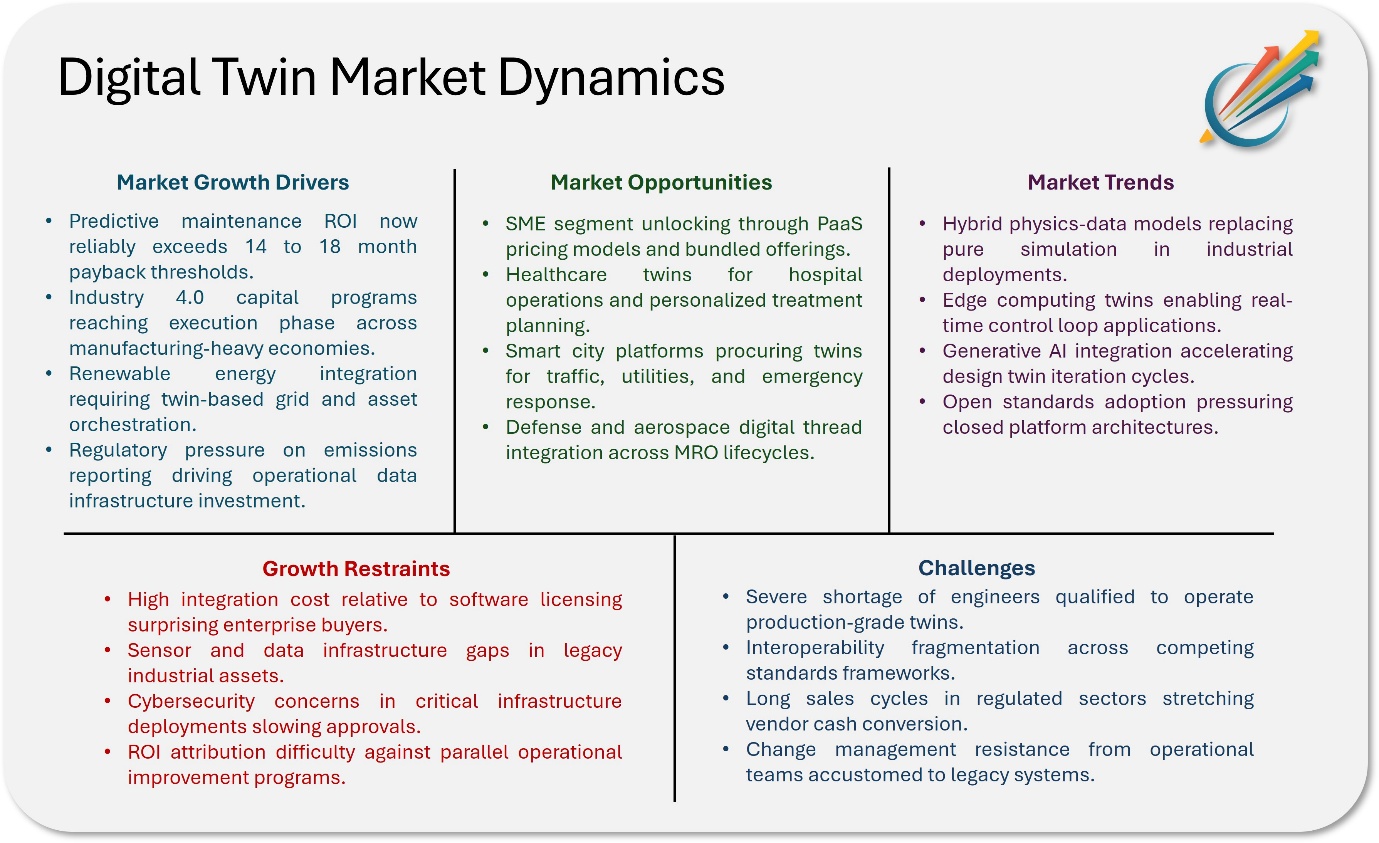
Digital Twin Market Segmentation
By Technology Type
- Physics-Based Simulation
- Data-Driven Modelling
- Hybrid Physics-Data Models
- 3D Visualization and Rendering
- Real-Time Stream Processing
- Machine Learning and AI Analytics
- Edge Computing Digital Twins
- Others
Hybrid physics-data models are emerging as the dominant architecture for industrial applications, displacing pure simulation in mission-critical contexts. Machine learning and AI analytics are growing fastest in percentage terms, particularly where pattern recognition outperforms first-principles modelling. The digital twin market is now organized less by individual technology choice and more by how vendors combine these layers into integrated stacks aligned with specific buyer use cases.
By Deployment Type
- Cloud-Based Deployment
- On-premise Deployment
- Hybrid Deployment
- Platform-As-A-Service (PaaS) Model
Cloud-based deployment leads new contract volume in commercial and consumer-facing applications. Hybrid deployment dominates regulated and asset-intensive sectors where data sovereignty and latency requirements override pure cloud economics. PaaS models are reshaping mid-market access, particularly where equipment OEMs bundle twin capability with hardware sales. The digital twin market shows clear divergence between regulated and unregulated sectors on architectural preferences.
By Enterprise Size
- Small And Medium Enterprises (SMEs)
- Large Enterprises
- Public Sector / Government Agencies
Large enterprises account for the majority of current spending, driven by multi-asset operators in energy, transportation, and manufacturing. SMEs represent the highest-growth cohort as PaaS pricing collapses entry barriers. Public sector adoption is concentrated in smart city, defense, and utilities programs, often procured through systems integrators rather than direct vendor relationships. Segment economics differ substantially across these three cohorts.
By Application
- Product Design
- Process Optimization
- Predictive Maintenance
- Operations Monitoring
- Performance Simulation
- Supply Chain Optimization
- Energy Management
- Quality Assurance
- Virtual Training
- Urban Planning & Smart City Management
Predictive maintenance and process optimization deliver the most defensible ROI in current deployments and dominate enterprise budget allocation. Product design twins are foundational in automotive and aerospace, with adoption now extending into consumer electronics and medical devices. Supply chain and energy management applications are growing fastest in the digital twin market as enterprises seek resilience and sustainability outcomes simultaneously.
By End Use
- Energy and Utilities
- Oil & Gas
- Automotive & Transportation
- Aerospace and Defense
- Healthcare
- Buildings and Construction
- Semiconductor and Electronics
- Telecommunications
- Retail and E-Commerce
- Others
Energy, utilities, and oil and gas account for the largest current spend, reflecting asset complexity and regulatory pressure. Automotive and aerospace deploy the most architecturally mature implementations, often spanning full product lifecycles. Healthcare and construction are emerging as the highest-growth verticals as twins move from facility operations into clinical and structural use cases.
Shape this report around your priorities: https://marketmindsadvisory.com/request-customization/?report_id=34
Regional Market Outlook
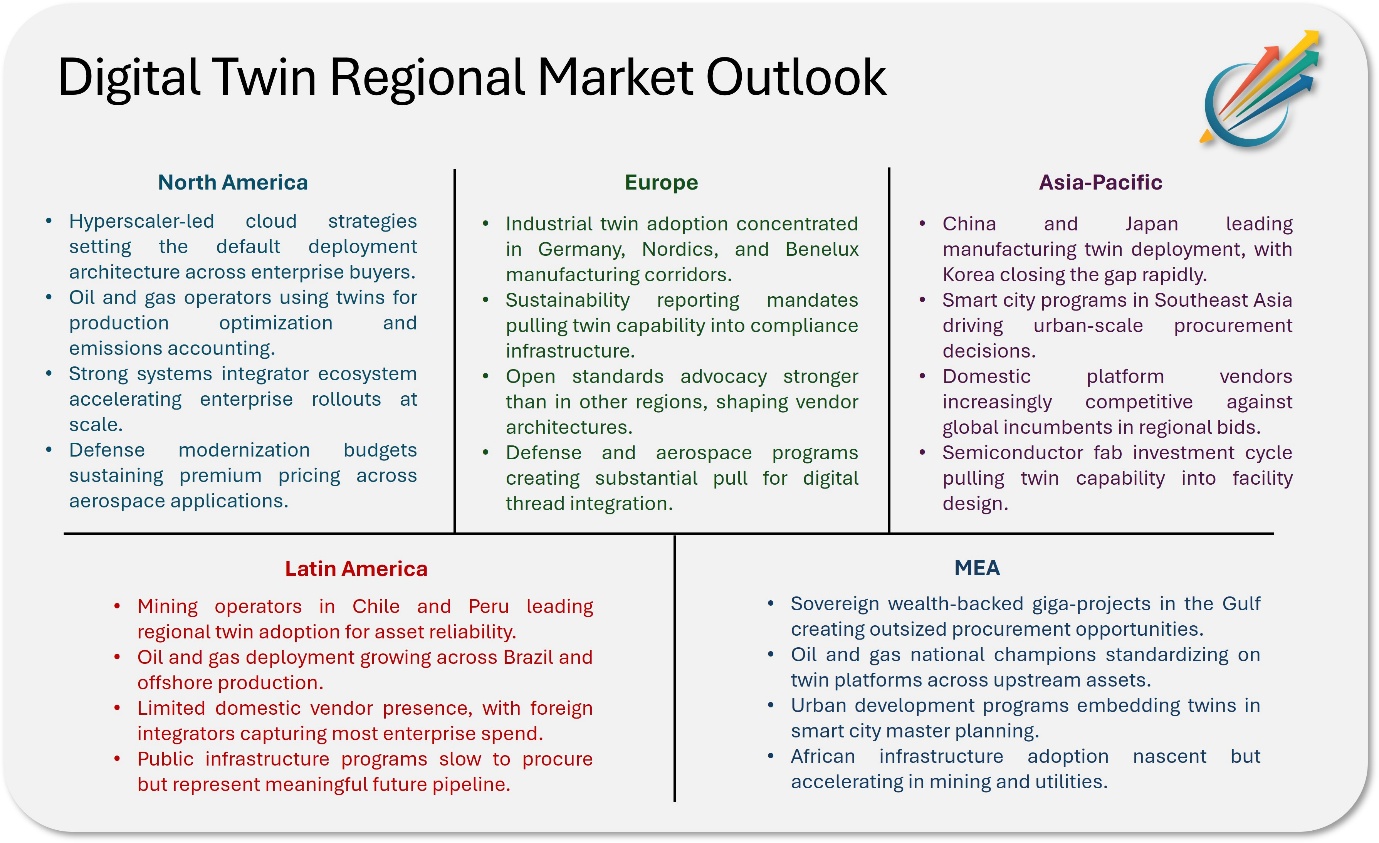
Investment Focus where the Significant Opportunity is Anticipated
Vertical platform specialists
Vendors building deep vertical capability on top of horizontal data layers are capturing premium margins. Their defensibility comes from accumulated domain models, regulatory familiarity, and customer reference networks that horizontal players cannot replicate quickly. This category will likely consolidate through acquisition over the next 36 months.
Edge-native twin architectures
Companies designing twins for edge deployment from inception, rather than retrofitting cloud platforms downward, are winning in latency-sensitive industrial contexts. The technical moat is real, and the buyer pull from manufacturing and energy operators is structurally durable across the next investment cycle.
Data and integration layer providers
The unglamorous middleware layer connecting OT systems, ERP, and twin platforms is where integration cost concentrates. Vendors solving this credibly are increasingly bundled into enterprise twin deals as mandatory components rather than optional add-ons, creating attractive economics for focused players.
Sustainability and ESG-linked twin applications
Twins built specifically for carbon accounting, resource optimization, and ESG reporting are accessing buying influence in finance and sustainability functions. This category enjoys regulatory tailwind and budget access that purely operational twins cannot match, making it one of the more defensible opportunity zones in the digital twin market.
What This Means for Decision-Makers
Industrial Operators - The cost of waiting now exceeds the cost of acting. Enterprises that have not yet committed to a digital twin market architecture should treat the next two budget cycles as decisive rather than exploratory. Compounding data advantages do not catch up easily once competitors are 24 months ahead.
Platform Vendors - The defensible position is no longer breadth of features. It is the depth of vertical partnerships and the quality of the integration layer beneath the platform. Pure horizontal plays will face margin compression as buyers demand specialist domain capability bundled into procurement.
Investors - The digital twin market has matured past pure software speculation. Integration capability, vertical specialization, and edge architecture represent more defensible positions than horizontal platform exposure alone. Valuation discipline matters more in this cycle than in the prior one.
Policymakers - Twin infrastructure is becoming foundational to industrial competitiveness, emissions accountability, and critical infrastructure resilience. Public procurement frameworks and standards-setting choices made in the next 24 months will shape regional vendor ecosystems for the following decade.
Competitive Landscape: Digital Twin Market
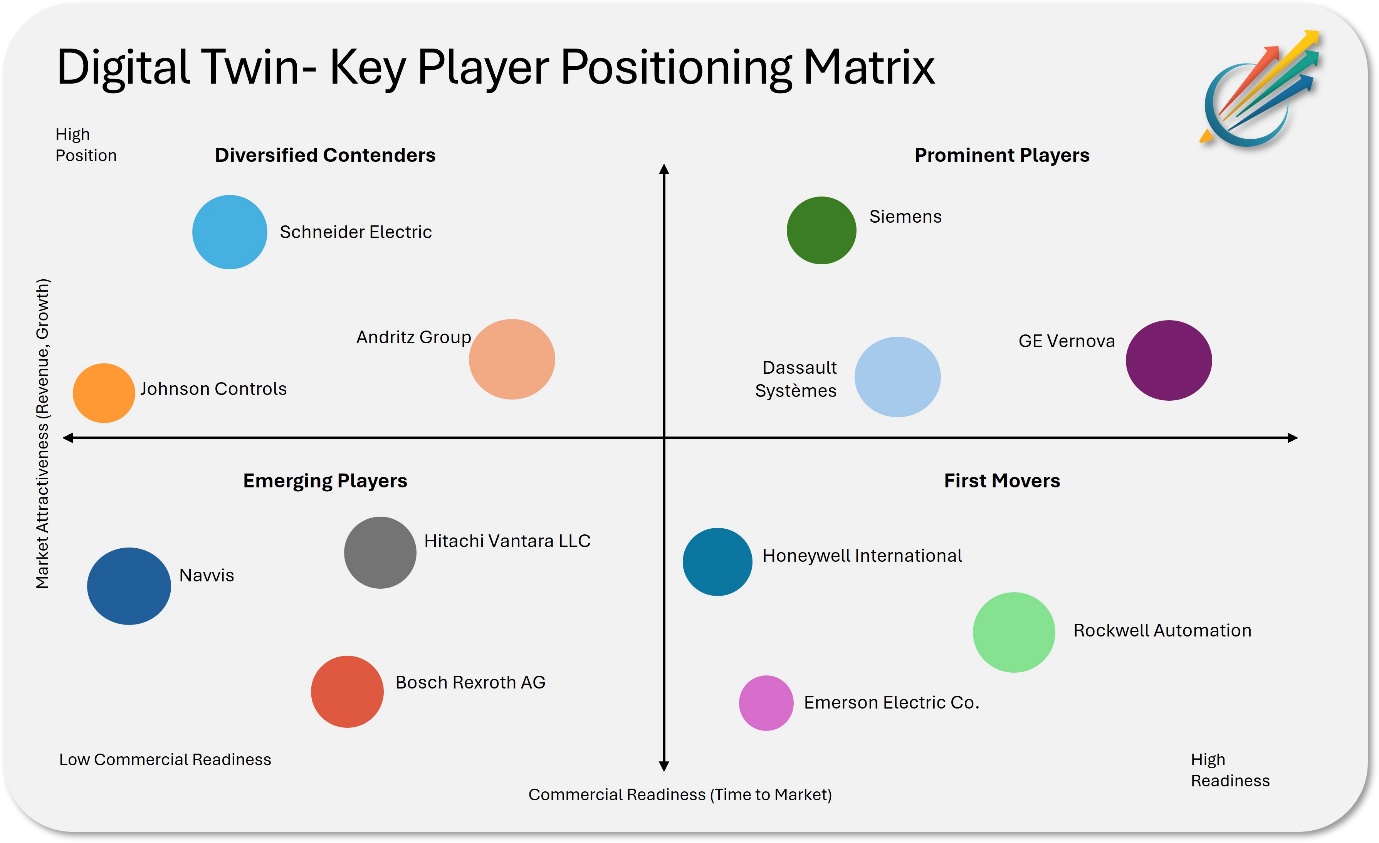
Recent Market Developments
- In March 2026, Siemens expanded its Xcelerator platform with additional industrial AI capabilities targeting predictive maintenance and process optimization use cases.
- In February 2026, Dassault Systèmes announced extended healthcare applications of its virtual twin technology for hospital operations and clinical workflow modelling.
- In January 2026, IBM deepened its partnership ecosystem around watsonx and digital twin offerings for asset-intensive industries including energy and manufacturing.
- In December 2025, PTC reinforced its industrial software strategy with continued investment in ThingWorx and Vuforia for connected operations deployments.
Market is segmented by Technology Type (Physics-Based Simulation, Data-Driven Modelling, ML and AI Analytics), Deployment Type (Cloud-Based, On-premise, Hybrid), Application (Predictive Maintenance, Process Optimization, Supply Chain Optimization, etc), and End Use (Energy & Utilities, Automotive & Transportation, Aerospace & Defense, etc)
Get Access to complete Analysis, Buy Now: https://marketmindsadvisory.com/buy-now/?report_id=34
Trending Reports
- Industrial PC Market
- Machine Condition Monitoring Market
- 4K Technology Market
- Aviation Analytics Market
- Pharmaceutical Manufacturing Equipment Market
- AI in Mining Market
- Fabric Spreading Machine Market
- High-Availability Server Market
- In-flight Internet Market
- Industrial Wireless Broken Signal Solutions Market
Why choose Market Minds Advisory
Market Minds Advisory delivers decision-grade intelligence to executives across machinery, packaging, chemicals, automotive, ICT, food and beverage, consumer goods, and healthcare. We help organizations sharpen market expansion strategies, accelerate share gains, refine brand positioning, and enable account-level growth. Our forecasting integrates primary interviews, proprietary demand models, and continuous market validation, producing the kind of clarity volatile and emerging industries require. Backed by over a decade of sector expertise, our research surfaces white space, opportunity gaps, and competitive blind spots, accounting for recent developments and geopolitical risk. We help businesses see the future of their markets.
Contact Us
Market Minds Advisory
1521 Concord Pike, Suite 301
Wilmington, DE 19803
United States
Email: sales@marketmindsadvisory.com
Website: https://marketmindsadvisory.com/


Legal Disclaimer:
EIN Presswire provides this news content "as is" without warranty of any kind. We do not accept any responsibility or liability for the accuracy, content, images, videos, licenses, completeness, legality, or reliability of the information contained in this article. If you have any complaints or copyright issues related to this article, kindly contact the author above.
